Business vs Entrepreneurship: Understanding the Key Differences for Long-Term Success
Business vs Entrepreneurship: Which Path Is Right for You?
Many people use the terms business and entrepreneurship interchangeably, but they represent different approaches to creating income, building wealth, and making an impact. While every entrepreneur may own a business, not every business owner is an entrepreneur.
Whether you’re launching a startup in Texas, opening a local retail shop, or building an online company, understanding the differences between business ownership and entrepreneurship can help you make better decisions for your future.
What Is a Business?
A business is an organization that provides products or services to customers in exchange for revenue. Businesses can range from small family-owned companies to multinational corporations.
The primary goal of most businesses is to generate consistent profits while serving customer needs. Successful businesses often focus on improving efficiency, maintaining customer satisfaction, and growing steadily over time.
Need some help advertising? Well look no further we are here to help! Click here to contact us today!
Characteristics of a Business
- Provides products or services
- Generates consistent revenue
- Focuses on profitability
- Builds customer loyalty
- Operates using established systems
- Prioritizes stability and long-term sustainability
Examples include:
- Restaurants
- Law firms
- Construction companies
- Medical clinics
- Retail stores
- Marketing agencies
- Security companies
- Real estate firms
What Is Entrepreneurship?
Entrepreneurship is the process of identifying opportunities, solving problems, and creating innovative businesses that often disrupt existing markets.
Entrepreneurs typically accept higher risks in exchange for greater growth potential. They focus on innovation, scalability, and creating value through new ideas, products, or services.
Many successful entrepreneurs begin with a single idea that eventually grows into a nationally recognized company.
Characteristics of Entrepreneurship
- Innovation-driven
- High-growth mindset
- Willingness to take calculated risks
- Solves market problems
- Creates scalable business models
- Continuously adapts to market changes
Business vs Entrepreneurship: Major Differences
Purpose
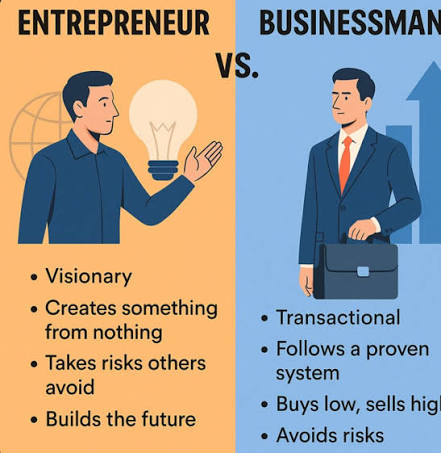
A traditional business focuses on earning steady income and maintaining profitability.
Entrepreneurship focuses on creating innovative solutions while pursuing rapid growth and market expansion. 
Risk
Business owners often operate with predictable business models and lower financial risk.
Entrepreneurs generally face greater uncertainty because they introduce new ideas, products, or technologies.
Growth Strategy
Businesses usually grow gradually by increasing customers, locations, or services.
Entrepreneurial ventures often aim for rapid scaling through technology, investment, franchising, or nationwide expansion.
Innovation
Traditional businesses frequently improve existing products or services.
Entrepreneurs seek to create entirely new products, industries, or customer experiences.
Financial Goals
Business owners often prioritize stable cash flow and sustainable profits.
Entrepreneurs may initially sacrifice profits to achieve long-term growth and market leadership.
Similarities Between Business Owners and Entrepreneurs
Despite their differences, both share many common goals:
- Creating value for customers
- Building strong brands
- Managing finances effectively
- Hiring talented employees
- Developing marketing strategies
- Improving customer experiences
- Increasing profitability
Success in either path requires dedication, planning, and continuous learning.
Advantages of Owning a Business
Owning a traditional business offers several benefits:
- Predictable income potential
- Lower operational risk
- Easier financial planning
- Established customer demand
- Greater long-term stability
- Opportunities for local community growth
Many successful small businesses become valuable assets that can be sold or passed down to future generations.
Advantages of Entrepreneurship
Entrepreneurship provides unique opportunities for ambitious innovators.
Benefits include:
- Unlimited growth potential
- Greater earning opportunities
- Creative freedom
- Industry leadership
- Ability to solve major problems
- Potential to attract investors
- Building nationally recognized brands
Entrepreneurs often create jobs while contributing to economic development.
Challenges of Business Ownership
Business owners may encounter challenges such as:
- Increasing competition
- Rising operating costs
- Hiring qualified employees
- Managing cash flow
- Economic uncertainty
- Regulatory compliance
Strong management and strategic planning can help overcome these obstacles.
Loving the article so far check out our News page for the latest article.
Challenges of Entrepreneurship
Entrepreneurs face additional hurdles including:
- Limited startup capital
- Higher financial risk
- Market uncertainty
- Product development costs
- Investor expectations
- Scaling operations
- Intense competition
Persistence and adaptability are often key factors in entrepreneurial success.
Business and Entrepreneurship in Texas
Texas continues to be one of the best places in the United States to start a business or launch a startup. Cities such as Houston, Dallas, Austin, San Antonio, and Fort Worth offer thriving economies, skilled workforces, and strong support for small businesses and entrepreneurs.
The state’s diverse industries—including energy, healthcare, technology, logistics, manufacturing, construction, and real estate—create opportunities for both traditional business owners and innovative entrepreneurs.
How to Decide Which Path Fits You
Ask yourself the following questions:
- Do you enjoy improving existing businesses or creating something entirely new?
- Are you comfortable taking financial risks?
- Do you prefer stable income or rapid growth opportunities?
- Are you passionate about solving large-scale problems?
- Do you enjoy innovation and continuous change?
Your answers can help determine whether traditional business ownership or entrepreneurship aligns better with your goals.
Final Thoughts
Business ownership and entrepreneurship each offer rewarding paths to financial success and professional fulfillment. A business focuses on stability, customer service, and consistent profitability, while entrepreneurship emphasizes innovation, calculated risk-taking, and scalable growth.
Regardless of the path you choose, success depends on careful planning, market research, effective leadership, and a commitment to delivering value. By understanding the differences between business and entrepreneurship, aspiring professionals can build stronger companies, adapt to changing markets, and create lasting impact in their communities.